

Highway Moto Rush: Traffic
AxesInMotion Racing
Highway Moto Rush: Traffic immediately puts me in the mindset of a quick, focused ride rather than a long-form racing campaign. I pick a motorcycle, enter traffic, and concentrate on the narrow space between speed and a mistake. That simple setup suits short sessions well: it is the kind of racing game I can open when I have a few spare minutes and want something more active than a puzzle but less demanding than a full console-style racer.
My first impression is shaped by the contrast between realistic road presentation and straightforward arcade pressure. The setting is familiar—highway traffic, moving vehicles, and a motorcycle threading through danger—but the appeal comes from how quickly that familiar scene becomes tense. Every vehicle turns into a timing problem. I am not only trying to go fast; I am judging gaps, deciding whether a pass is worth the risk, and reacting before the road closes.
That focus makes the game easy to understand without making every run feel identical. The basic objective is clear from the start, yet the experience depends on how confidently I handle the traffic. Highway Moto Rush: Traffic works best when I treat each ride as a test of control and attention rather than as a race with a traditional pack of opponents.
How the road creates its own visual language
The art direction is built around recognition. A highway is not an elaborate fantasy world, so the game has to make speed and danger readable through the road itself. Lane markings, vehicle silhouettes, open gaps, and sudden obstacles become the visual vocabulary. I can understand the situation at a glance, which matters in a game where hesitation is often more damaging than a slightly imperfect line.
I like that the setting supports the central fantasy without distracting from it. The road feels like a place for movement, not a backdrop competing for attention. The motorcycle is the point of view, and the surrounding traffic gives every decision context. A clear stretch invites acceleration, while a dense group of vehicles changes the mood into careful observation. That shift happens through the arrangement of the road rather than through lengthy explanations.
Related News






The realistic direction also creates a useful trade-off. A grounded highway scene makes the danger feel believable, but it leaves less room for visual spectacle than a brightly colored arcade racer. Players who want dramatic tracks, unusual vehicles, or a heavily stylized world may find the presentation restrained. I see that restraint as intentional, though: the game wants me to read traffic quickly, not stop to admire a complicated environment.
For practical play, this visual clarity is more important than decoration. I can imagine using the game during a commute break or while waiting for an appointment, when I may not want to learn a new map or remember a complicated upgrade tree. The road communicates its challenge immediately. That is one of the strongest design choices here, because the short-session format depends on reducing the time between opening the game and making the first meaningful decision.
Why the setting works better for some players than others
The highway setting is a good fit if I enjoy the feeling of weaving through traffic and improving my reactions. It is less suitable if I need a strong sense of exploration. There is no promise in the basic concept of discovering a large world or following a character-driven journey, so I would not choose this over a track-based racer for someone who wants varied circuits and a clear championship structure.
Gallery
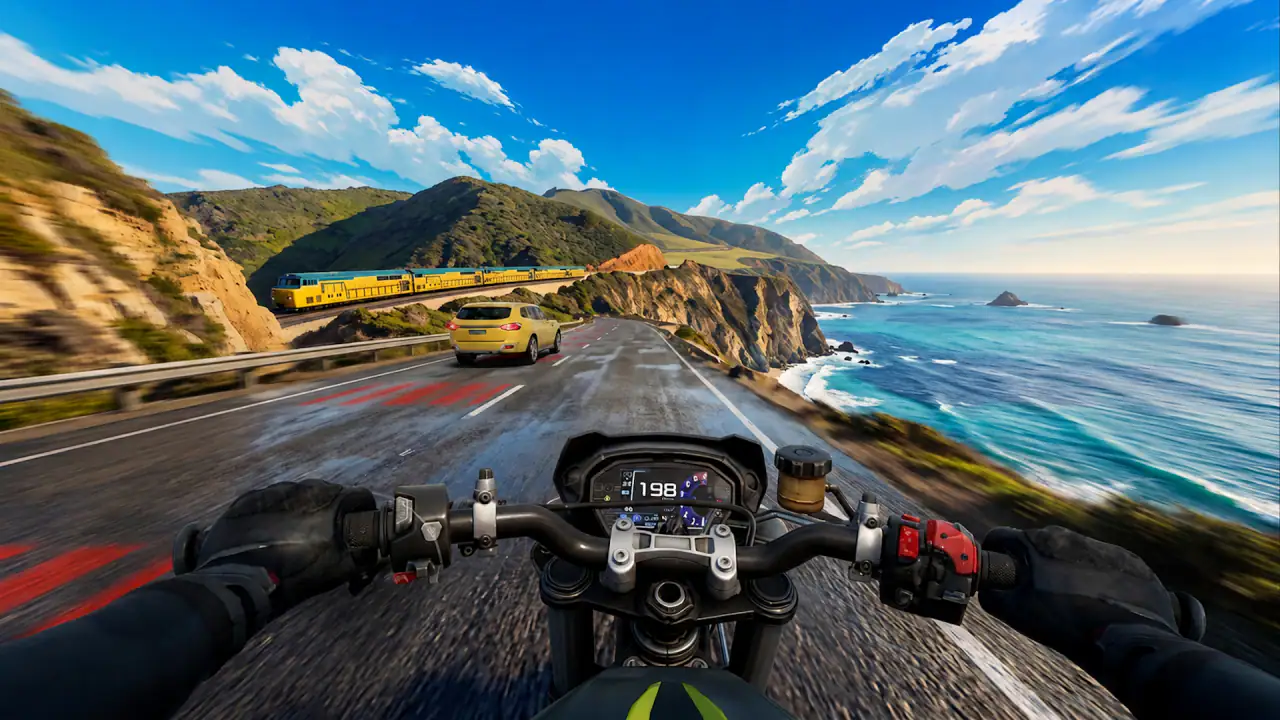
Instead, the game creates variety from traffic density and the changing value of each gap. A wide opening is not automatically the best choice; taking it may require a longer movement across lanes, while a smaller opening may keep the motorcycle aligned for the next decision. That is a subtle but important difference from simply holding the accelerator and steering toward empty space.
My useful tip is to read two or three vehicles ahead rather than reacting only to the nearest one. The closest car tells me what I must avoid now, but the next vehicles reveal whether the apparent escape route is actually safe. This forward-looking habit makes the road feel less random and gives the game a small layer of planning that is easy to miss in a first session.
Sound, speed, and the rhythm of a run
The mood of a traffic racer depends heavily on rhythm. Visuals show me what is happening, but sound helps turn separate steering decisions into a continuous ride. In this kind of game, the motorcycle’s movement, the surrounding traffic, and the pressure of approaching danger need to feel connected. When those elements line up, even a short attempt can feel purposeful rather than disposable.
I experience the pacing as a cycle of confidence and interruption. An open lane lets me settle into speed, then a cluster of vehicles forces a quick change in attention. That pattern is more effective than constant chaos because it gives me a moment to prepare before asking for a precise response. If every second were equally frantic, mistakes would feel exhausting instead of exciting.
The setting also benefits from a restrained mood. A highway ride naturally suggests motion, repetition, and concentration. The game does not need a complicated story to establish that atmosphere. Its identity comes from the steady forward view and the pressure to maintain a clean line. I find that useful when I want a game that occupies my hands and eyes without demanding emotional investment in characters or plot.
There is a trade-off here for players who prefer a more expressive audio-visual package. A traffic-focused racer can begin to feel repetitive if the road, sound, and pacing do not develop enough over time. I would approach this title expecting a focused driving mood, not a soundtrack-led experience or a cinematic journey. Its success depends on whether the simple act of surviving traffic remains satisfying for me.
One practical approach is to play in short blocks and stop after a particularly clean run instead of forcing a long session. The game’s mood is strongest when concentration is fresh. After repeated attempts, I notice the road less as a place and more as a pattern, which can make errors feel automatic. Short sessions preserve the tension that gives the presentation its purpose.
When the pacing becomes the real challenge
The most interesting part of the pacing is that speed is not always the same as progress. A fast approach to a tight group can leave me with fewer options, while a brief adjustment can create a safer line through the next section. That makes patience part of the racing fantasy. I am still riding fast, but I am also managing when to commit.
This is where the game can appeal to players who enjoy reaction games with a planning edge. It is not deep simulation, yet it rewards awareness beyond simple left-and-right movement. I have to recognize the rhythm of traffic, anticipate how one pass affects the next, and avoid spending all my attention on the immediate obstacle.
For someone who wants a relaxed game, however, that rhythm may be too demanding. The realistic traffic theme suggests danger, and the core pleasure comes from managing it. I would skip this one if I wanted a calm ride with forgiving turns or a sightseeing experience. The atmosphere is coherent precisely because the road keeps asking me to stay alert.
Where the mechanics support the mood
The mechanics fit the presentation because the road is both the world and the challenge. There is no need for a separate explanation of why I should care about traffic: the vehicles directly interrupt my route. The motorcycle gives the game its vulnerability, while the highway provides a continuous stream of decisions. That connection makes the experience easy to grasp and gives the realistic direction a playable purpose.
As a free game from AxesInMotion Racing, it has an accessible starting point for people curious about motorcycle traffic racing. The age classification is Everyone, which makes the premise broadly approachable. That does not mean every player will enjoy the pressure, but it does mean the game’s central idea is easy to share with casual players who want a clear objective and immediate action.
The current version is 1.4.1, and the game has passed the early discovery stage with more than one hundred thousand installs. Its average rating is 4.4 from hundreds of ratings, which suggests that the basic traffic-riding formula connects with a meaningful group of players. I treat those figures as useful context rather than a substitute for personal fit: a strong average cannot change the fact that repetition may bother someone who needs extensive progression.
The game is free to start, but in-app purchases range from less than a dollar to amounts approaching one hundred dollars per item. That is the point I would consider carefully before spending. A free entry price is convenient for testing the handling and atmosphere, yet the presence of high-priced individual purchases means I would avoid buying anything until I knew whether the core ride held my attention over several sessions.
My recommendation is to establish a personal rule before playing: enjoy the free experience first, then decide whether any optional purchase genuinely improves the way I play. I would not treat a purchase as a solution to weak engagement. If the traffic rhythm does not feel satisfying on its own, extra spending is unlikely to fix that. This is especially relevant for younger players, even with an Everyone content rating, because purchase decisions should remain deliberate.
A realistic everyday use case
Imagine I have ten minutes before a meeting. I do not want to begin a long campaign, wait through a complicated setup, or remember a detailed objective. I can use this game for a quick concentration break: start a ride, settle into the highway rhythm, and make a few careful passes. If I fail, the reason is usually understandable in the moment—I committed too early, misread the next vehicle, or let speed outrun my available space.
That clarity makes the game useful as a compact reflex exercise. I can focus on one improvement, such as looking farther ahead or leaving more room after a pass, rather than trying to master a large collection of systems at once. The session has a natural endpoint when my attention drops, which is better than a game that encourages me to continue while I am already playing carelessly.
On the other hand, I would not choose it for a long flight or an evening when I want a sense of progression to occupy me for hours. The highway format is strongest in bursts. A traditional racing game with multiple tracks, structured events, and broader vehicle customization would be a better alternative for a player who measures value through variety and long-term goals.
Small decisions that make the ride more consistent
My first technique is to avoid treating every opening as an invitation. A gap has value only if it leaves a useful next position. Passing into a space that immediately narrows can create a second problem before I have recovered from the first. I get better results by choosing lines that preserve options, even when they look slightly slower.
My second technique is to separate observation from acceleration. When the road opens, I can increase speed, but I should first check how traffic is arranged farther ahead. This prevents the common mistake of gaining momentum just before a dense cluster. The game’s mood encourages speed, yet the mechanics reward timing more than reckless commitment.
My third technique is to use mistakes as information about rhythm. If I repeatedly collide in the same type of situation, I do not need to blame the traffic immediately. I may be entering groups too quickly, changing direction too late, or focusing on the nearest vehicle. Reviewing the moment in simple terms turns a short arcade run into a small learning loop.
These habits are not advertised features; they are ways I found to get more from the design. They also explain why the game can feel more thoughtful than its one-line premise suggests. The mechanics remain simple, but the best play comes from managing attention and space rather than moving as fast as possible at every moment.
Who should play it and who should look elsewhere
I would recommend this game to someone who likes motorcycle themes, quick traffic challenges, and realistic road settings that remain easy to read. It is particularly suitable for players who want a short-session racer with an immediate premise. The combination of a free starting point, an Everyone age classification, and a focused highway scenario makes it approachable for casual testing.
I would be more cautious with players who need a strong career mode, elaborate track variety, or a story that gives every session a larger purpose. The game’s identity is concentrated around riding through traffic. That focus is a strength when I want repetition with improving control, but it becomes a limitation when I want a broad racing package.
It is also not my first choice for someone seeking a pure motorcycle simulator. The realistic presentation should not be confused with a full technical simulation of riding. The appeal is the readable danger and fast decision-making of traffic, not the promise of detailed mechanical management. A dedicated simulation would better suit a player interested in authentic bike setup and nuanced track behavior.
Compared with endless-runner alternatives, this game feels more grounded because the highway and vehicles shape the challenge. Compared with conventional circuit racers, it offers less emphasis on learning a fixed course and more emphasis on reacting to a changing stream of obstacles. That middle position is its clearest identity: it is more involved than simply surviving a repeating path, but more immediate than entering a structured race weekend.
The release date is Jun 12, 2026, and that places the game in a current mobile context while keeping the recommendation practical: I would judge it by the quality of its central ride, not by expecting a huge catalog of systems. Its developer, AxesInMotion Racing, has chosen a concept that can be understood in seconds. The important question is whether I enjoy refining my decisions on the same kind of road.
My verdict on the atmosphere and the ride
Highway Moto Rush: Traffic succeeds when its art direction, sound, and pacing all point toward one feeling: staying composed while moving quickly through danger. The highway is recognizable, the traffic is immediately meaningful, and the motorcycle keeps me close to every mistake. I appreciate that the presentation does not try to bury the mechanics. The mood comes directly from the act of riding.
Its biggest strength is coherence. The realistic road setting is not just decoration; it makes gaps, lanes, and vehicles readable. The pacing is not merely fast; it gives me alternating moments of confidence and pressure. The mechanics do not ask me to manage an oversized system; they ask me to see ahead, choose a line, and commit at the right time.
Its main weakness is the same narrow focus that makes it memorable. Players who enjoy the traffic challenge may find plenty to refine, while players who need extensive progression or dramatic variety may lose interest sooner. I also recommend caution around the available in-app purchases, particularly because the game is free to begin but includes individual items priced from $0.99 to $94.99.
For me, this is best as a compact, alerting racing game rather than an all-purpose driving title. I would install it when I wanted quick motorcycle action, a clear visual setting, and a challenge that rewards looking beyond the next obstacle. I would skip it in favor of a traditional racer when I wanted championships, varied circuits, or deeper simulation. If the simple act of finding a clean line through traffic sounds satisfying, this focused highway ride is worth trying before deciding how far I want to take it.
FAQs for Highway Moto Rush: Traffic
What is Highway Moto Rush: Traffic?
Highway Moto Rush: Traffic is an arcade-style motorcycle racing game focused on weaving through busy roads at high speed. After testing the game, I found that its main appeal is the quick, pick-up-and-play gameplay: you control a motorcycle, avoid cars and other traffic, and try to travel as far as possible while earning rewards. It is designed more for short action sessions than for a realistic motorcycle simulation.
How do you play Highway Moto Rush: Traffic?
The controls are straightforward and suitable for mobile devices. You generally guide the motorcycle through traffic by steering left and right, while speed and movement depend on the game’s control system and selected settings. The goal is to avoid collisions, pass vehicles closely when possible, and complete objectives or distance challenges. New players should begin carefully, because traffic patterns become harder to predict as speed increases.
Does Highway Moto Rush: Traffic work offline?
The game may allow some core racing activities to be played without a constant internet connection, which is useful when traveling or when mobile data is unavailable. However, features such as advertisements, bonuses, online services, cloud-related functions, or certain updates may require internet access. Before relying on offline play, it is best to test the installed version in airplane mode, since requirements can change between updates and devices.
Is Highway Moto Rush: Traffic free to download and play?
Highway Moto Rush: Traffic can generally be downloaded at no initial cost, but free mobile games commonly include advertising and optional in-app purchases. These purchases may provide currency, upgrades, vehicles, or other advantages, depending on the current version. You can usually make progress without spending money, although repeated attempts and waiting through ads may be part of the experience. Check the store listing for the latest pricing information.
Is Highway Moto Rush: Traffic suitable for children?
The game is easy to understand, but parents should review its age rating and store description before allowing children to download it. Fast traffic, crashes, advertisements, and optional purchases may affect suitability for younger players. The gameplay itself is not complicated, yet children may be encouraged to watch ads or buy virtual items. Using parental controls and disabling unauthorized purchases is recommended on shared devices.
Pros
- Fast-paced traffic dodging feels exciting from the first ride.
- Simple controls make the game easy to pick up on mobile.
- Short races are convenient for quick gaming sessions.
- Multiple bikes add variety and encourage continued progression.
- Bright visuals and road effects create an energetic arcade atmosphere.
Cons
- Frequent near misses can feel frustrating when traffic patterns are unpredictable.
- Progress may become repetitive after mastering the main road challenges.
- Some upgrades can require considerable grinding to unlock.
- The game may feel too demanding on older or less powerful devices.
- Ads may interrupt play or slow down the overall experience.


